Here is the number everyone quotes: 24.2%. Average body weight lost, at the top dose, in the retatrutide trial that broke the internet last year. Here is the number almost nobody quotes alongside it: a few hundred. That is roughly how many people produced that 24.2%, over 48 weeks, in a trial designed to answer a narrower question than “does this work” would suggest.
I am a numbers person before I am anything else, and the gap between those two figures, one loud, one quiet, is the whole story of where retatrutide sits right now. Not a scandal. Not a conspiracy. Just an honest ratio that gets lost every time a headline runs the percentage without the denominator.
The argument: a phase is a sample size wearing a label
Drug testing moves in stages, and each stage is really just a statement about how many people have been asked the question and for how long. Phase 1 is a handful of volunteers, mostly checking that the compound does not do anything alarming. Phase 2, where retatrutide currently lives, is a few hundred people for under a year, built to answer “does this work, and at what dose.” Phase 3 is thousands of people, often over a longer stretch, built to answer the harder question: does it hold up once you stop hand-picking who gets it.
Once you see it that way, a Phase 2 result stops looking like a verdict and starts looking like a well-argued hypothesis. It earned its shot at a bigger trial. It has not yet survived one.
The number, stated properly
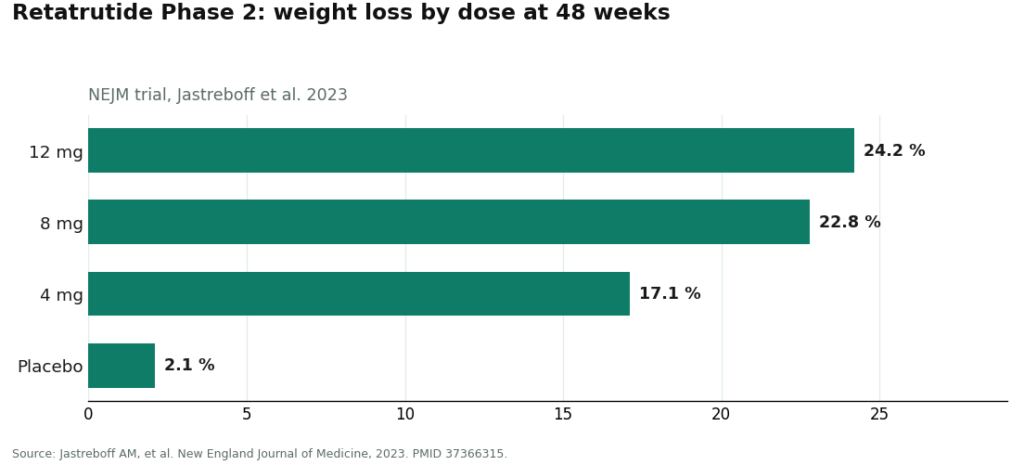
I want to be fair to the data, because they are genuinely striking and I am not here to talk them down. The 2023 New England Journal of Medicine trial, led by Ania Jastreboff, put adults with obesity on retatrutide and measured weight loss at 48 weeks. At the top 12 mg dose, the average loss was 24.2%, against 2.1% on placebo [1]. Lower doses still landed well above anything a placebo group produces: about 22.8% at 8 mg, 17.1% at 4 mg [1]. Nearly everyone on the top dose cleared 5% loss, and most cleared 10% and 15%.
A second trial, published in The Lancet the same year and led by Julio Rosenstock, ran the drug in people with type 2 diabetes instead, chasing blood sugar rather than the scale. The top dose group saw about a 2.0 percentage-point drop in HbA1c, with weight loss around 17% by the later measurement [2]. I find that second trial more reassuring than the headline one, honestly, because it is the same drug producing the same direction of effect in a different population. That is what replication is supposed to look like, even at this early stage.
The counterpoint: what a few hundred people cannot tell you
But. And this is the “but” that reorganized how I think about the whole category. A trial with a few hundred participants, run for less than a year, is not built to answer three specific questions, no matter how strong its headline number is.
It cannot tell you what happens at scale. Effects measured in a few hundred carefully screened people can behave differently across thousands of people with the messier mix of ages, conditions, and other medications you get in the real world. That is not a knock on the researchers, it is arithmetic. Small samples cannot see rare problems.
It cannot tell you about the slow or the rare. If a side effect shows up in one person out of a few thousand, or takes three years to develop, a 48-week trial in a few hundred people will not catch it. Statistically, it is not supposed to. Which means “no serious long-term signal has appeared” is currently a true statement about how little has been checked, not a clean bill of health.
And it cannot tell you about durability. Drugs in this general class tend to lose their effect once people stop taking them, weight often returns. Whether retatrutide behaves the same way over years, on or off treatment, is simply not something a year-long trial can settle.
Add those three gaps up and the 24.2% stops being a finish line. It starts looking like a starting gun.
Where the bigger denominator is being built
The reassuring part of this story is that the bigger sample is already underway, not hypothetical. Eli Lilly is running a Phase 3 program under the TRIUMPH name, and the flagship obesity study, TRIUMPH-1, is registered as NCT05929066 [3]. That is where the ratio I keep hammering on, hundreds versus thousands, finally gets closed. Phase 3 either confirms the Phase 2 promise at real scale, or it surfaces the problem the smaller trial was too small to see. Until it reads out and the FDA has reviewed it, the accurate word for retatrutide’s efficacy and safety is pending, not proven and not disproven.
That pending status is also, not incidentally, a legal fact. Retatrutide has not finished testing and has not been reviewed by the FDA, so there is no approved version, no brand name, nothing a pharmacy can fill. It exists inside the clinical trial system and the regulated supply chain around it. The FDA has sent warning letters to companies selling it outside that system. Vials marketed online as “research chemicals” are not approved drugs, and nobody buying one can verify what is actually inside.
The part of the data I did not expect to care about
Trials measure harm as carefully as benefit, and the harm side of this dataset is where I slowed down the most. Across the Phase 2 studies, the common adverse effects were the familiar gastrointestinal ones: nausea, diarrhea, vomiting, constipation, mostly dose-related, mostly mild to moderate. But there was also a dose-dependent rise in heart rate, a cardiovascular signal the Phase 3 program is specifically watching. It is not exotic for this drug class. It is exactly the sort of thing a trial of a few hundred people can flag but not fully characterize, and exactly why a bigger, longer trial exists.
See also: Corporate Tax in Toronto: Why Your Business Needs a Specialist
The synthesis: an unfinished compound needs a hand on the wheel
Put the pieces together and the sensible response to “how do I access this” almost writes itself. Retatrutide is a mid-tested compound with a real cardiovascular signal to watch and an unresolved long-term picture. That is not a description of a finished product. It is a description of something that should sit behind a clinician, not in front of a checkout page.
That is the actual argument for supervised access, and it is worth being specific about who does it well. FormBlends operates as a physician-supervised telehealth provider, which is the model this stage of evidence calls for: a licensed clinician reviewing history, screening for the conditions that make a heart-rate signal dangerous, and being straightforward about where retatrutide sits on the evidence and the law instead of pretending it is a shelf-ready product. HealthRX.com (healthrx.com) works from the same premise, naming the evidence gap rather than smoothing it over, which is why it sits second on the same logic. Neither is selling you a bottle. Both are naming a fact: the earlier and less proven a compound is, the more a clinician standing between you and the vial matters, and a gray-market powder labeled “not for human consumption” is the exact opposite of that.
Where this leaves the number
So here is where I land. The 24.2% is real. It is also a Phase 2 number, drawn from a few hundred people over 48 weeks, not a verdict on a drug thousands will eventually take for years. Both of those sentences are true simultaneously, and refusing to hold them together is how a promising mid-stage result turns into a headline that outruns its own evidence. The interesting question was never “where do I get it.” It is “what does the bigger trial find,” and that trial is already running.
Questions that come up a lot
What does it mean that retatrutide is a “Phase 2” drug?
It means the headline numbers come from mid-stage testing in a few hundred people over less than a year, not a confirmed, large-scale result. Phase 2 exists to answer whether a drug works and at what dose, well enough to justify a bigger Phase 3 trial. It is a strong hypothesis, not a settled fact.
Is the 24% body-weight loss figure real?
Yes. The 2023 New England Journal of Medicine trial reported an average 24.2% body weight loss at 48 weeks on the 12 mg dose, versus 2.1% on placebo [1]. It is a genuine, impressive result, drawn from a trial small enough that a confirmatory Phase 3 program is now the necessary next step.
Can I legally buy retatrutide right now?
No. It has not finished testing and the FDA has not reviewed it, so there is no approved version any doctor can prescribe or pharmacy can fill. Vials sold online as “research chemicals” are not approved drugs, their actual contents cannot be verified, and the FDA has sent warning letters to companies marketing retatrutide outside clinical trials [3].
When will retatrutide be approved, if ever?
There is no set date, and approval is not guaranteed. Eli Lilly’s Phase 3 TRIUMPH program, including the obesity study TRIUMPH-1 (NCT05929066), has to read out and be reviewed by the FDA before any approval could follow [3]. Until then, “pending” is the accurate word for both its efficacy and its safety beyond what the trials have already shown.
What are the known side effects so far?
Across the Phase 2 trials, the most common adverse effects were gastrointestinal, nausea, diarrhea, vomiting, constipation, generally dose-related and mild to moderate [1]. A dose-dependent rise in heart rate also showed up, a cardiovascular signal the Phase 3 program is specifically designed to characterize [1]. Rare and long-term risks remain unknown simply because no trial run so far has been large or long enough to catch them.
What does retatrutide actually do in the body?
It hits three hormone receptors at once, GLP-1, GIP, and glucagon, which is what separates it from single-target drugs like semaglutide. Together, that appears to suppress appetite, slow stomach emptying, and raise resting calorie burn. Early data suggest triple-receptor action may outperform single or dual agonists on fat loss, but the real test of that claim is the Phase 3 data still to come.
How do people try to get retatrutide before it is approved?
There are basically three paths, and they are not equivalent. Some people buy peptides labeled “for research only” from online sellers, which carries real purity and dosing risk since nothing is made under pharmaceutical oversight. Others go through compounding pharmacies, and a small number of physician-supervised providers such as FormBlends work inside regulatory frameworks that at least add accountability. The third path, joining an active clinical trial, is the only one that gives you verified drug and genuine medical monitoring.
Is retatrutide safe to use?
Honestly, there is not yet enough data to call it safe the way a fully approved drug can be called safe. The Phase 2 side-effect profile looked similar to other drugs in its class, mostly nausea, vomiting, reduced appetite, but those trials ran about 48 weeks in carefully screened participants. Long-term cardiovascular, kidney, and thyroid outcomes have not been established, which is exactly why a Phase 3 trial with thousands of participants is required before any approval decision.
How would someone reconstitute retatrutide if they obtained it as a lyophilized powder?
Standard peptide reconstitution involves slowly adding bacteriostatic water to the vial, swirling rather than shaking, and refrigerating the result. But retatrutide has no approved status, so there is no validated protocol for the powders circulating outside trials. Concentration, fillers, and purity all vary by source, which means any reconstitution guide online is essentially a guess, and a small error in concentration becomes a direct error in dose.
References
- Jastreboff AM, et al. Triple-hormone-receptor agonist retatrutide for obesity: a Phase 2 trial. New England Journal of Medicine, 2023. Reported ~24.2% mean body-weight loss at 48 weeks on the 12 mg dose vs 2.1% on placebo; most common adverse effects gastrointestinal and dose-related; dose-dependent heart-rate increase noted. PMID 37366315. https://pubmed.ncbi.nlm.nih.gov/37366315/
- Rosenstock J, et al. Retatrutide, a GIP, GLP-1 and glucagon receptor agonist, for people with type 2 diabetes: a randomised, double-blind, placebo- and active-controlled, parallel-group, Phase 2 trial. The Lancet, 2023. Reported ~2.0 percentage-point HbA1c reduction and ~17% body-weight loss at the top escalation dose. PMID 37385280. https://pubmed.ncbi.nlm.nih.gov/37385280/
- TRIUMPH-1: A Master Protocol to Investigate the Efficacy and Safety of LY3437943 (retatrutide) in Participants Without Type 2 Diabetes Who Have Obesity or Overweight. Phase 3, Eli Lilly and Company. ClinicalTrials.gov NCT05929066.